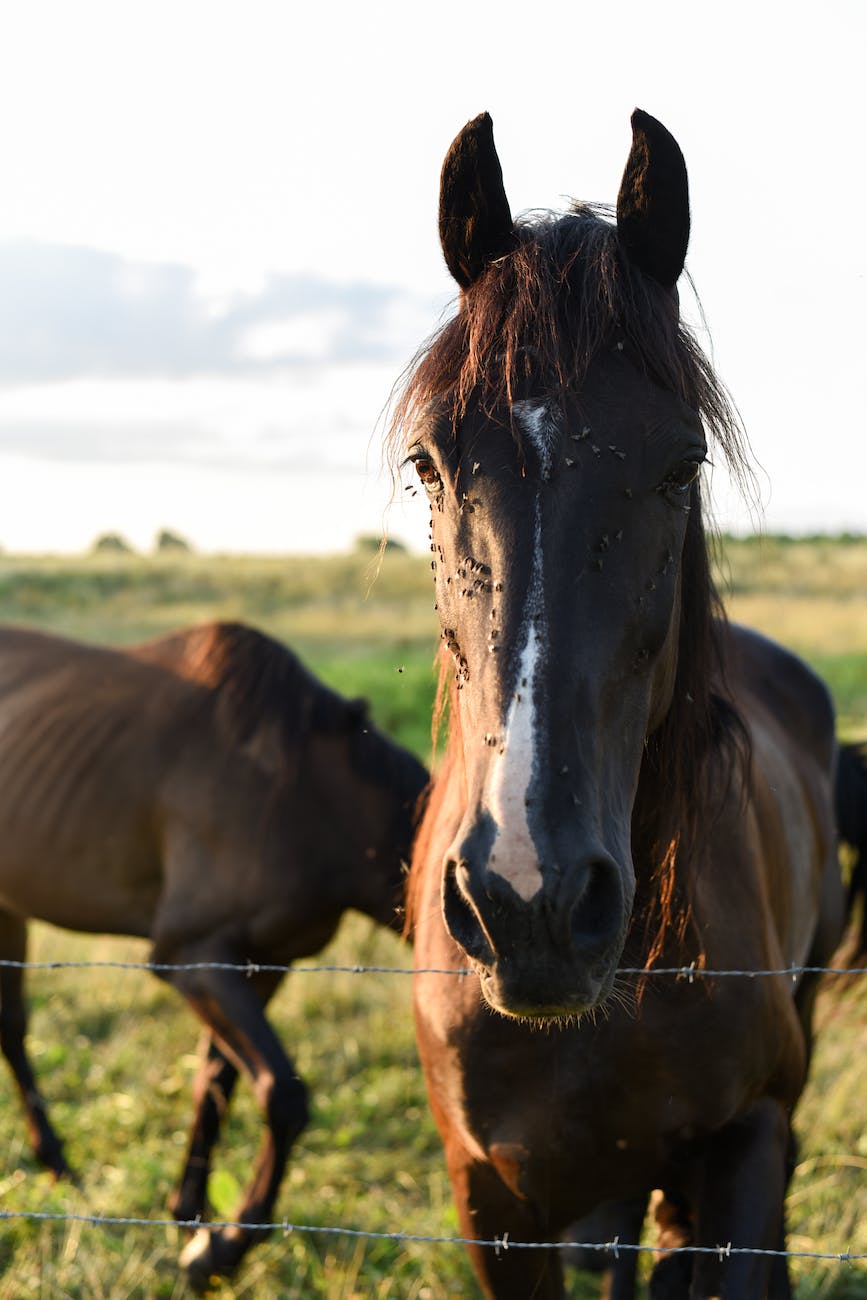
At Grass by Philip Larkin

The eye can hardly pick them out
From the cold shade they shelter in,
Till wind distresses tail and mane;
Then one crops grass, and moves about
- The other seeming to look on -
And stands anonymous again

Yet fifteen years ago, perhaps
Two dozen distances sufficed
To fable them: faint afternoons
Of Cups and Stakes and Handicaps,
Whereby their names were artificed
To inlay faded, classic Junes -

Silks at the start: against the sky
Numbers and parasols: outside,
Squadrons of empty cars, and heat,
And littered grass: then the long cry
Hanging unhushed till it subside
To stop-press columns on the street.

Do memories plague their ears like flies?
They shake their heads. Dusk brims the shadows.
Summer by summer all stole away,
The starting-gates, the crowd and cries -
All but the unmolesting meadows.
Almanacked, their names live; they

Have slipped their names, and stand at ease,
Or gallop for what must be joy,
And not a fieldglass sees them home,
Or curious stop-watch prophesies:
Only the grooms, and the grooms boy,
With bridles in the evening come.
Human memory is a fickle companion. Sometimes it comes in handy (e.g., “The last time these factors converged I got into trouble”), but other times it interferes with our perception of the present moment like flies on the horses’ ears in Larkin’s lovely poem.
The biggest lie of human memory is that it feels true. Although our recollections seem like literal snapshots of the past, they’re actually deeply flawed reconstructions, a set of stories constantly undergoing rewrites.
Neuroscientists tell us that summoning the past to the surface actually changes the memory itself. The details of our recollections are always being reconstructed, reshaped by our current feelings and knowledge. The more you remember an event, the less reliable that memory becomes. The vast number of “facts” that people remember are far from the truth, in fact, many are more fantasy than truth.
What’s worse is that when people are collectively nostalgic about an event or an era as a group, rather than individually nostalgic for their personal experiences, they start to identify more intensely with their own group and judge members of other groups more negatively. This is the curse of the generations.
The intensification of divisiviness in the United States is largely due to this phenomenon. It is intensified bt the fact that those rallying the war cries are deliberately tugging on these heartstrings.
When the pupeteers pull the strings, it seems as though there are only two choices: join in or withdraw.
As a result, some join in, become wistful, and take offense, while others withdraw, judge from afar off, and comdemn such foolishness. Sadly, both approaches are futile. Both perpetuate the problem rather than solving it.
In fact, vain regrets about the past are ALWAYS futile, regardless of whether that past was real or imagined, collectively or individually recalled. Such regrets shackle you to the past, deflect the currents of forgiveness and retard, if not defeat entirely, the healing process.
All action springs from internal orientation. Center in the past and you are doomed to repeat it. Center in something higher and you will be drawn into higher function in relation to the present.
 Gregory Hake