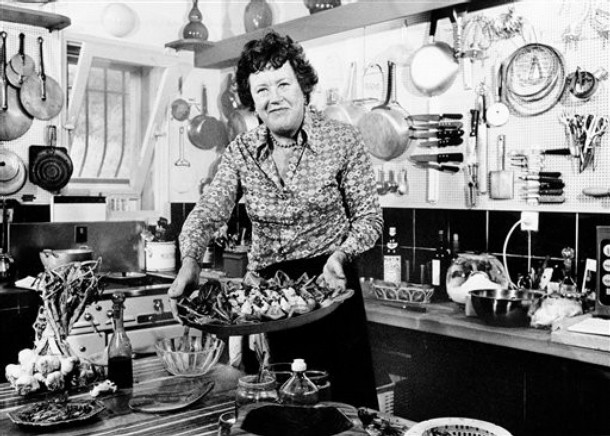
Julia prepared us for the filming by having my friends and I repeat tongue-twisters after her in an effort to get everyone to speak up and to speak clearly. While I don’t recall the dish we prepared, I do remember how much I appreciated her clarity of speech, her diction and her eloquent expression. She was truly inspiring!
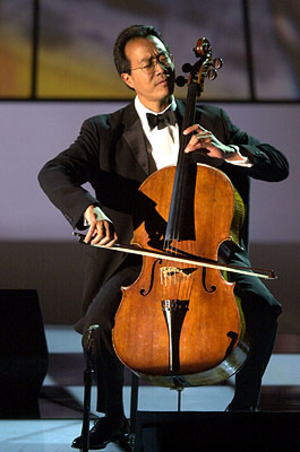
Born in France, Yo-Yo Ma was another patron of the French Library in Boston. I had the good fortune to meet him during the same project and I recall that he, too, was well-spoken. His ability to speak seemed as much predicated on his ability to listen as anything else. A kind man, for sure, who like Julia, got me thinking about elocution.
To speak well you must think clearly. No doubt you’ve had the occasional “word salad” sentence come out of your mouth and what you said either made no sense or would have been more useful as a “quiet thought.” Conversely, I am sure there are times when you can say that you offered le mot juste, the right word at the right time. Increasing the frequency of the latter experience is my concern in writing this to you.
Grammar, vocabulary and articulation tend to imprison more than they liberate. Far too many people feel inadequate and embarrassed or even ashamed of their lack of ability in this area. Some blame a lack of proper education, others accuse themselves of not having listened while being given a good education, but the truth of the matter is that you can start where you are, always!
Fear not, le mot juste is on the tip of your tongue. I put together a list of best practices that will help you to loosen up, speak up and embrace the freedom of speech and expression that your forefathers were so careful to preserve.
- Take the time to listen more carefully to those you know who excel in this area. Listen not only to the content of their message, but also how they say what they’re saying.
- Take the time to look up words you don’t know. Not a day goes by where I do not consult a dictionary or a thesaurus to broaden and deepen my familiarity with language.
- Take an adult education or evening class on a foreign language you’ve always wanted to learn. Who knows where that will lead?!? Learning other languages can provide a remarkable window into you own language.
- Join Toastmasters (www.toastmasters.org) or a theater or improv group. There are chapters just about everywhere and these types of experiential organizations are not only fun, but inspiring!
- Read, read, read. Get your hands on books written by the best writers in a genre that interests you. Look up every word that you don’t know. Highlight phrases that stand out to you. Share them with others in your writing or conversation.
- Keep a journal, write a blog or if that is too daunting, start to make comments on blogs, share your reviews on books you’ve read online and look for any opportunity to share your thoughts. Get those wheels turning!
- Watch an old movie or read an old newspaper or magazine article (50+ years) every now and again. I feel that we use far less of the languages we share than our predecessors. Our values have changed and the rules don’t matter, bullet point, talk-like-you-text approach to language is transforming how we think and speak.
- Enjoy silence. Don’t be afraid of it. Every time you speak your vocal chords set a vibration in motion, one that is certain to change the world. Be sure that when you do speak that it enhances, not detracts.
- Try your hand at poetry. A friend of mine just started writing again and it is amazing to see what that medium, which requires connecting feelings to thoughts like no other, can open up in you!
I hope that you enjoy the rest of your weekend, my friends.
 Gregory Hake
Thank you Gregg,
Marie
LikeLike
Hi, Gregg
I just happened to find this post after having searched for ” word salad”. I was wondering how this “word salad” can befall anyone.
I found your Mot Juste. I love your post. I too love words. I speak 4 languages and it’s fun to see how many of the words come from one another. I have had people tell me that I am eloquent and articulate. I have found people who think that I am not modern because I am using an antiquated word. To some people this may be insulting, however, I take it as a compliment.
I prefer to use words that tell exactly what I feel, think and want to communicate. Those words may be antiquated or modern.
Again, I love your post.
Until we meet again
M
LikeLike
Thank you so much for stopping by, Marie!
LikeLike
Although public declarations and personal diatribes have their place, it really is nice to have a private space for your thoughts, such as a journal to get the wheels turning. When I was in college, I had to keep a journal and write in it every day. Part of the purpose was to learn how to let words flow without being worried about what I sounded like. The more I wrote, the easier it was to get my thoughts out – it was a good lesson. Cool blog – thanks!
LikeLike
One helpful resource I’ve found is “Grammar Girl.” She has a weekly podcast, but also posts everything on a website. Here is a link to the topic of writing blog comments, but make sure to search through her lists of topics. Helpful both for speaking and writing, plus it’s entertaining and interesting.
http://grammar.quickanddirtytips.com/how-to-write-a-blog-comment.aspx
LikeLike
Loved the link to Grammar Girl, Susan. Thank you!
LikeLike
A great opportunity to re-watch my database of old films (but with a different ear and paper, a pen and dictionary at hand)
LikeLike
Thanks for the tips on how to refine one’s expression here, Gregg. I’ve known people who may have the skills of, for example, active listening, analytical thinking and creative problem solving, but if there isn’t an ability to communicate clearly, respectfully and persuasively something ends up being stunted or even tragically lost. How important this is for any kind of personal or professional success.
LikeLike
How wonderful that you had opportunity to meet these individuals! I really am going to employ your suggestions. Have a great evening!
LikeLike
You too, thanks!
LikeLike
I have personally found Toastmasters to be an unparalleled resource for my professional growth, and it has connected me to a worldwide network of friends and associates. I have a Toastmaster’s Corporate Club in place at my company. I’ve learned that positive investments in people always pay big dividends and that encouraging others to excel in leadership ends up solving problems before they arise. So it has been a good strategy and investment for me, but any person could start with one or even a combination of your suggestions here and start experiencing results.
LikeLike
When I am in the company of someone that practices the distinct pronunciation of their words I can’t help but want to hear more from them. The words they speak are precise and never a word uttered that is not thought through. It is as if you are sitting on your chair waiting to hear their next thought but they do not speak until the thought is clear to them. We have all been in conversations that are going on and some one will say something and then the next thing out of their mouth is “Did I say that out loud”. Those are the thoughts that are better left unsaid. This is the time that silence is best. Also the silence is what allows others the opportunity to express themselves in a conversation. We want to jump right in and a lot of time the relaxation and silence in a conversation allows something totally different to be expressed.
Thanks for the practical tips!
LikeLike
Hey now, “OMG” is a word! LOL, Gregg
LikeLike
Great post Gregg! It is is so important for us to realize that the quality of our speech tells alot about who we are. I love learning foreign languages and writing poetry. The more I take the time to read great authors, I realize how much more I have to learn about my own language. Having teenagers around I do see how the texting world has changed our language and speech patterns. My children actually believe that (OMG) is a word. I appreciate your eloquence and your appreciation for the spoken word. Thanks!
LikeLike
These are great points that would help anyone become a better speaker and writer. I’ve always loved books, words and languages and am inspired to continue to learn and expand my understanding with your suggestions. It does seem like our present vocabulary is more limited than what it used to be. I was watching an old black and white movie the other day and noticed how different the diction, articulation and vocabulary was. Becoming a better speaker and writer is something we can improve upon and your thoughts are much appreciated. Thanks for this helpful post!
LikeLike
You bring up some great points in this post. Clear and articulate communication, both verbal and written, is an important thing that separates the good from the great. Like any other skill, it needs daily practice to be perfected. You can see that Julia Child knew that part of her show’s professionalism hinged on good host-audience communication, and she was able to coach her audience to communicate more clearly. Thanks for reminding me not to get complacent with this.
LikeLike