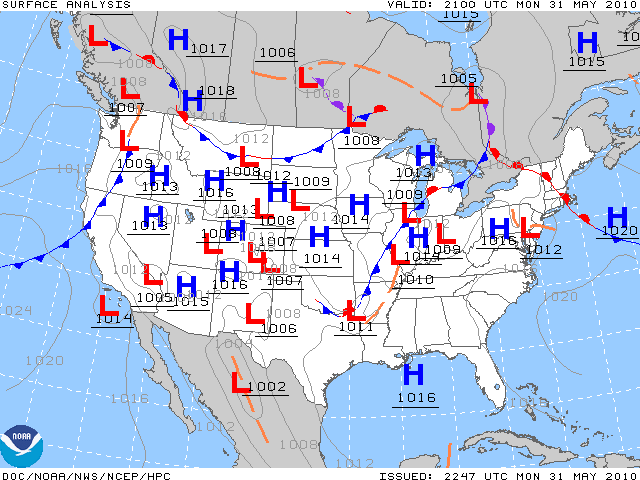
 I had the opportunity to make an in-depth study of the weather in the Southeast yesterday in preparation for a flight in a small aircraft. The latest “Surface Analysis” provided by www.aviationweather.gov showed a fascinating mix of both high and low pressure systems and warm and cold fronts scattered about the country.
Pilot and author Robert Buck wrote one of aviation’s classic books on meteorology called “Weather Flying.” This book is a must read for any pilot as well as for anyone with an interest in developing a deeper understanding of how weather forms and how changing weather effects decision-making in aviation. Buck made an interesting and valuable point in Chapter One that I would like to consider with you today:
The pilot’s weather philosophy has two parts. The first is skepticism. Being a weather skeptic is an important ingredient of the formula for living to a ripe old age. The second part is to always have an alternate plan of action. These two keys, skepticism and alternate action, are the foundation of it all.
While this thinking provides a useful framework for pilots considering the weather during flight planning and in flight, it isn’t a far stretch to see the value of skepticism and alternate planning for life in general. Let’s take a deeper look at these two points, specifically as they relate to a life well lived.
The skeptical attitude is of great value if doubt is an initial impression and not a foregone conclusion. The “honest skeptic” questions, probes, tests while leaving room for a new idea to be proven true or false. The “lesser skeptic” assumes something is false without having done his homework. A single honest skeptic is worth ten “yes men.”
Alternate plans are likewise tremendously useful, even if not utilized. The process of developing alternate plans implies that there was a “Plan A” in the first place. You have an idea of where you are going. You arose this morning with a purpose. The rest of the world, however, might not be aware of your plan. In fact, it is highly likely that your plan might be in conflict with someone else’s plan for the day, say that of your spouse, your co-worker(s) or your friend(s). Even if you push like there’s no tomorrow to execute “Plan A,” you might find it necessary to go with “Plan B.”
If life is like flying, you will probably find it easier to have thought through “Plan B” in the calmer planning phase of the flight than when you are in the thick of it. Some rely on quick thinking or the ability to “think on their feet,” a useful capability to be sure, but there is no harm in thinking through what the likely challenges will be, in advance of the actual event.
Fortune favors the honest skeptic and he who can plan effectively, yet remains flexible in the execution of a plan. Life, as we considered yesterday, is full of surprises and a rigid, myopic view on how to handle the unexpected will only yield frustration and eventually exhaustion. So doing allows you to enjoy the weather, no matter how it turns out.
There is little to no value in complaining about the weather, wishing it were different, etc. Follow Buck’s advice and come rain or shine, high pressure or low, you’ll make the best use of the days to come and hopefully live to a ripe old age!

 Gregory Hake

You know, with hindsight you sometimes find that the plan B you were forced into had a better outcome than plan A ever could have. You never know what life will bring!
LikeLike
I highly recommend Capt. Buck’s book. Indispensable training for pilots, useful reading really for anyone who is interested in ‘navigating’ … air, land, sea, life. The weather training is just as pertinent today as it was when I first got my instrument rating years ago, and the analogies from pilot training definitely have spilled over into the rest of my living. My son is a student pilot and I gave him this book as a gift. He’ll get a kick out of this post as he teases me for taking life experiences often back to a flying principle.
LikeLike
I am a “planner” but as I get older I realize the subtlety of becoming invested in the plan. Tradition, conventional thinking, habit, fear and on the contrary being cavalier, inexperienced, lazy or unaware can shape your plans more than facts and research if you are not as you describe thinking it through in a calmer phase.
Your ideas create some good questions in my thinking. The difference between a “yes man” and a “team player”. When does an honest skeptic become a pessimist?
Life is full of surprises and those that seem to navigate best realize that the process of thinking is a learned skill. It seems to me the majority of what is called thinking is really habit and reaction.
Love your blog; it makes me think but some subjects I realize I have more questions than answers.
LikeLike
Very useful point about forming a plan B option in the moments of relative calm. I honestly can say I rarely would consider doing this except in an obvious situation like needing an alternative plan in case of rain. But there is plenty of wasted energy that I can see everyday from not thinking like that. How much that would save the total chaos that usually ensues when plan A fails. A little forethought is a simple way to continue on easily with nary a glitch. I look forward to practicing it!
LikeLike
Interesting to note the difference between an ‘honest’ and a ‘lesser’ skeptic. I’d venture to say an honest skeptic is worth much more than ten “yes men”!
LikeLike
Fantastic analogy!
LikeLike